How to Build a Compact Home Gym in a Small Apartment — Complete Guide
Updated: May 20
Can You Build a Real Home Gym in a Small Apartment?
Yes — but only if you start with the right question. The right question is not "how do I fit gym equipment into my apartment" but "which exercises do I actually want to do, and what is the minimum equipment that covers them." Most people who try to build a home gym in a small space fail because they buy equipment for exercises they imagine doing rather than exercises they actually do consistently. This guide covers how to assess your space honestly, which equipment covers the most ground in the least space, and what a realistic compact home gym looks like across different budgets and room sizes.
How Much Space Does a Home Gym Actually Need?
Less than most people assume — if the equipment is chosen correctly.
A standard apartment spare room or dedicated corner of a living room typically offers between 4 and 8 square metres of usable floor space. This is enough for a complete strength and cardio setup if you choose compact, multi-use equipment rather than full-size gym machines.
The key is understanding that home gym equipment falls into two categories:
Fixed footprint equipment stays in one place permanently. A walking pad, an exercise bike, or a pull-up bar mounted in a door frame all require dedicated space that is always occupied. Plan for this space to be unavailable for anything else.
Stored equipment is used and put away. Resistance bands, a foam roller, and a jump rope all store in a drawer or bag when not in use. These add zero permanent footprint to your room.
A well-planned compact home gym combines a small amount of fixed footprint equipment with a full set of stored equipment — covering cardio, strength, and recovery without permanently dedicating more than 2-3 square metres of floor space.

What Equipment Covers the Most Ground in the Least Space?
Resistance bands — the highest space-to-coverage ratio of any equipment
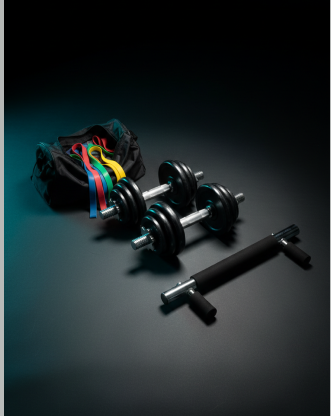
The PeakFit P-4 resistance band set — loop bands and long bands in graduated resistance levels — stores in a bag the size of a water bottle and covers the full range of upper body, lower body, and core exercises. A complete set of resistance bands replaces a rack of dumbbells for most bodyweight-focused training. They weigh under 500 grams and occupy zero floor space when stored.
Adjustable dumbbells — one set replaces twelve
The PeakFit K-4 adjustable dumbbell set adjusts from light to heavy on a single unit. Where a traditional dumbbell rack requires 2-3 metres of dedicated wall space, a pair of adjustable dumbbells sits on a shelf or in a corner and occupies a footprint smaller than a shoebox. For strength training in a compact home this is the single most efficient purchase.
Door frame pull-up bar — uses existing architecture
The PeakFit V-2 pull-up bar mounts in any standard door frame without drilling and removes in seconds when not needed. It adds upper body pulling capacity — pull-ups, chin-ups, and hanging exercises — to your training without occupying any floor space at all. When placed on the floor it functions as an elevated push-up and dip stand. One product, two functions, zero permanent footprint.
Suspension trainer — full body from one anchor point
The PeakFit P3 suspension trainer attaches to any door frame and enables over 100 bodyweight exercises from a single anchor point. Rows, press movements, squats, lunges, core work — all from a device that stores in a small bag. The P3 is the closest thing to a complete home gym in a single product.
Walking pad — permanent footprint, maximum daily use
The PeakFit W-1 walking pad requires a permanent floor space of 108cm by 52cm. It does not fold. Plan for this space to be unavailable for other use. In exchange it gives you the ability to walk at desk pace — 1-6km/h — continuously throughout a working day, which no other compact equipment provides. If you work from a standing desk or have space for a dedicated walking station, the W-1 adds a category of daily movement that stored equipment cannot replicate.
Exercise bike — quietest cardio, smallest footprint for a machine
The PeakFit VELO-8 exercise bike uses magnetic resistance which produces no friction noise during a session. It folds for storage and has a smaller floor footprint than a treadmill at any comparable output level. For apartment cardio where noise is a concern the exercise bike is the most practical choice.
What Does a Compact Home Gym Actually Cost?
Three budget levels — all based on actual PeakFit products:
Entry level — under £130
P-4 Resistance Bands Set — £44.99
V-2 Door Frame Pull-Up Bar — £49.99
R-4 Foam Roller — £42.99
Total: £137.97
Covers: Full body strength,
        upper body pulling,
        basic recovery
Mid level — under £250
K-4 Adjustable Dumbbell Set — £79.99
P3 Suspension Trainer — £77.99
J-1 Smart Jump Rope — £46.99
R-4 Foam Roller — £42.99
Total: £247.96
Covers: Progressive strength training,
        full body suspension work,
        cardio, recovery
Full setup — under £500
K-4 Adjustable Dumbbells — £79.99
P3 Suspension Trainer — £77.99
VELO-8 Exercise Bike — £157.99
P-4 Resistance Bands — £44.99
N-7 Neck Massager — £80.99
R-4 Foam Roller — £42.99
Total: £484.94
Covers: Complete strength, cardio,
        recovery, and wellness
How Do You Set Up a Home Gym in a Small Room?
Step 1 — Measure before buying anything
Measure your available floor space and ceiling height. Note the door frame width — the V-2 pull-up bar fits standard frames between 60 and 90cm wide. Note any obstacles — radiators, light switches, plugs — that would prevent equipment placement.
Step 2 — Decide what you will actually do
Be honest. If you have not done pull-ups in years, a pull-up bar will sit unused. If you walk or cycle for cardio, start there. If you do bodyweight strength training, resistance bands and a suspension trainer cover you completely. Buy for your actual training habits, not your aspirational ones.
Step 3 — Fix footprint equipment first
Decide where fixed equipment will live permanently. Mark it on a floor plan sketch. Everything else fits around it.
Step 4 — Add stored equipment to fill the gaps
Once fixed equipment is placed, fill the remaining training categories with stored equipment — bands, foam roller, jump rope — that lives in a bag or drawer when not in use.
Step 5 — Test before committing
Start with stored equipment only. Use it for 4-6 weeks. Identify what is missing from your training. Then add fixed equipment based on what you have actually tried to do and could not, rather than what you imagine you will do.
Frequently Asked Questions
How much floor space does a home gym need in a small apartment? A functional home gym can fit in as little as 2 square metres of permanent floor space combined with stored equipment that packs away when not in use. A walking pad requires 108cm by 52cm permanently. An exercise bike folds to a smaller footprint. Resistance bands, pull-up bars, and suspension trainers add zero permanent floor space.
Is it worth building a home gym in a rented apartment? Yes — if you choose equipment that does not damage the property. The PeakFit V-2 pull-up bar mounts without drilling. Resistance bands, dumbbells, and suspension trainers require no wall fixtures. A walking pad sits on the floor without anchoring. None of these require modifications that would affect a tenancy.
What is the best first piece of equipment for a compact home gym? A resistance band set covers the most training categories at the lowest cost and zero floor space. The PeakFit P-4 set includes loop and long bands in graduated resistance levels and stores in a carry bag. It is the most practical starting point for a compact home gym regardless of your fitness level.
Can you build muscle with compact home gym equipment? Yes — adjustable dumbbells and resistance bands provide enough progressive resistance for meaningful muscle development. The PeakFit K-4 adjustable dumbbell set and P-4 resistance band set together cover the full range of compound and isolation exercises. The limiting factor is consistency, not equipment.
How do you keep a home gym tidy in a small space? Store everything in designated spots — a dedicated shelf for dumbbells, a hook for resistance bands, a bag for the suspension trainer. Fixed equipment like a walking pad or exercise bike should be in a position where they do not need to be moved between sessions. The less you have to set up and pack away, the more consistently you will train.
What home gym equipment is best for someone who works from home? The most practical combination for a desk-based working day is a walking pad or pedal exerciser for continuous movement during work hours and resistance bands or dumbbells for dedicated strength sessions. The PeakFit W-1 walking pad and F-2 pedal exerciser are both designed specifically for concurrent desk use.

Explore the full PeakFit home gym range — K-4 Adjustable Dumbbells, P3 Suspension Trainer, P-4 Resistance Bands, V-2 Pull-Up Bar, W-1 Walking Pad, VELO-8 Exercise Bike.
The Zero-Equipment Athlete blueprint covers how to build a consistent training routine using compact equipment in a home or apartment setting — available with your order at peakfitstore.com.
Comments